
New Theory Could Dramatically Expand the Search for Aliens
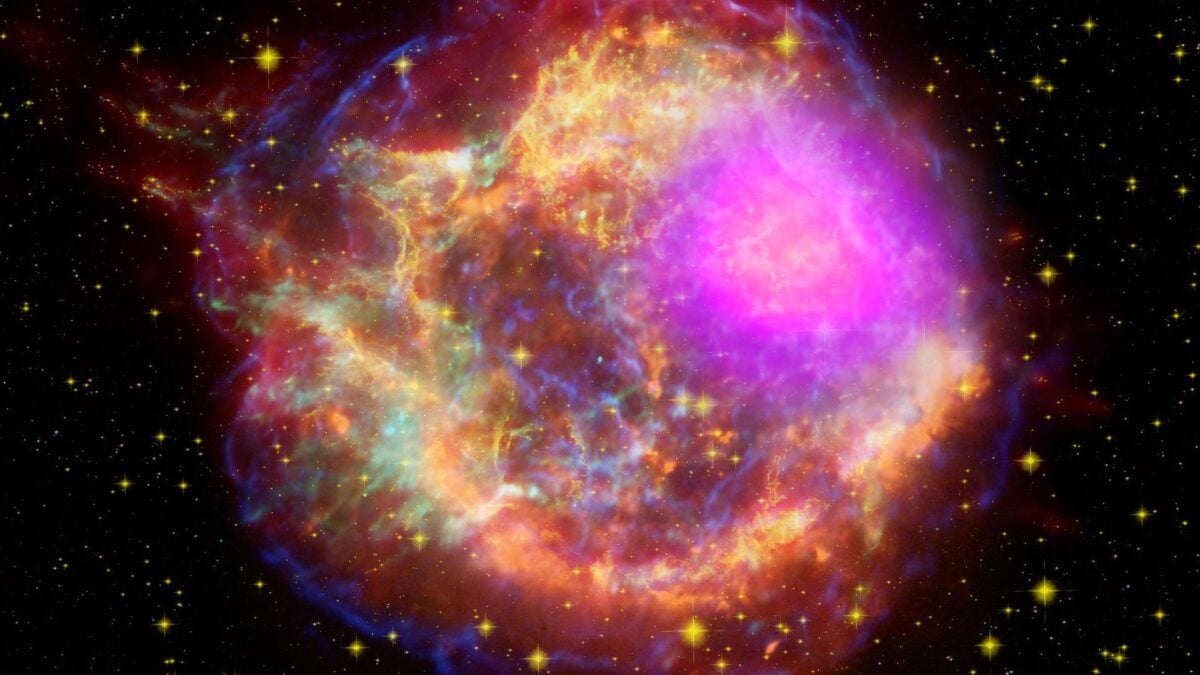
The search for alien life is largely centered on finding planets in the “Goldilocks Zone”—the distance from a star where a planet could have liquid water on its surface and enough light to sustain life. But a new study offers a tantalizing possibility that other worlds, far from their host stars, may also be able to support living things, a finding that could dramatically broaden the search for extraterrestrial life.
In a paper published last week in the International Journal of Astrobiology, researchers describe how cosmic rays—high-speed beams of particles pinging across the universe—could carry enough energy to sustain life. These rays can penetrate deep into the interior of planets far from their host stars, where they could strike underground reservoirs of water. The impact from the rays would split the water particles, releasing electrons in a process called radiolysis.
Certain microbes that are known to survive in dark, cold environments on Earth sustain themselves using this mechanism. If alien life could survive on radiolysis, as the findings suggest, then astronomers may need to reevaluate what is considered the habitable zone.
Led by New York University Abu Dhabi’s Center for Astrophysics and Space Science, the researchers ran computer simulations to determine how different levels of cosmic ray exposure might influence the surfaces of three cold bodies in our solar system: Mars, Enceladus (one of Saturn’s moons), and Europa (a moon of Jupiter).
Specifically, they wanted to see whether cosmic rays could trigger radiolysis there, and especially on the two moons, as astronomers have long believed they could have water below their icy surfaces.
The team found that Enceladus was the most promising candidate for sustaining life via radiolysis, although the simulations suggested that all three bodies could support some level of radiolysis, according to the paper. The researchers suggest that astronomers should expand what they think of as the habitable zone, dubbing this larger arena the Radiolytic Habitable Zone.
“This discovery changes the way we think about where life might exist,” lead study author Dimitra Atri said in a statement. “Instead of looking only for warm planets with sunlight, we can now consider places that are cold and dark, as long as they have some water beneath the surface and are exposed to cosmic rays. Life might be able to survive in more places than we ever imagined,” he added.


 English
 Arabic
 French
 Spanish
 Portuguese
 Deutsch
 Turkish
 Italiano
 Russian
 Romaian
 Portuguese (Brazil)
 Greek
Greek