
You Don't Want to Know Where Scientists Just Found 27 Million Tons of Plastic
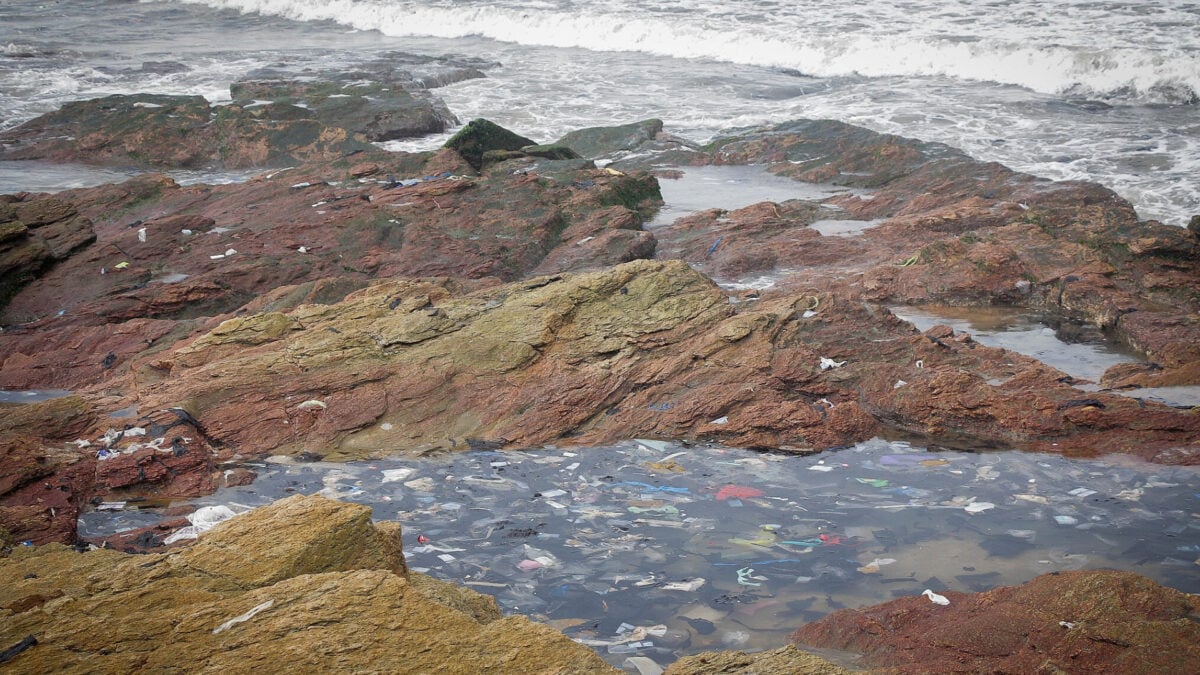
Despite the hundreds of millions of metric tons of plastic floating in our oceans—not to mention the microplastics in our saliva, blood, breast milk, and semen—researchers have been unable to account for all the plastic ever produced. A new study has just tracked down a large portion of it.
Researchers from the Royal Netherlands Institute for Sea Research (NIOZ) and Utrecht University claim to be the first to provide a real estimate of ocean-polluting nanoplastics. Their research indicates that the North Atlantic Ocean alone hosts 27 million tons of floating plastic particles less than 1 micrometer (μm) in size.
“Plastic pollution of the marine realm is widespread, with most scientific attention given to macroplastics and microplastics. By contrast, ocean nanoplastics (<1 μm) remain largely unquantified, leaving gaps in our understanding of the mass budget of this plastic size class,” they explained in a study published earlier this month in the journal Nature. “Our findings suggest that nanoplastics comprise the dominant fraction of marine plastic pollution.”
To reach these conclusions, Utrecht graduate student and study co-author Sophie ten Hietbrink collected water samples from 12 locations while working aboard a research vessel traveling from the Azores to the continental shelf of Europe. She filtered the samples of anything larger than one micrometer and conducted a molecular analysis on what was left behind. The team then extrapolated its results to the entire North Atlantic Ocean.
27 million tons is “a shocking amount,” Ten Hietbrink said in a NIOZ statement. “But with this we do have an important answer to the paradox of the missing plastic.” Namely, that a large part of it is floating in our oceans, invisible to the naked eye.
Unfortunately, there are a number of ways nanoparticles can end up in the oceans. While some likely arrive via rivers, others fall out of the sky with rain or on their own as “dry deposition.” (Yes, we’ve even found plastic pollution in the sky). Nanoparticles can also form when large pieces of plastic already in the ocean are broken down by waves and/or sunlight, according to the researchers. The question now is how this pollution is impacting the world and its creatures—including us.
“It is already known that nanoplastics can penetrate deep into our bodies. They are even found in brain tissue. Now that we know they are so ubiquitous in the oceans, it’s also obvious that they penetrate the entire ecosystem; from bacteria and other microorganisms to fish and top predators like humans,” said Helge Niemann, a geochemist at NIOZ and another co-author of the study. “How that pollution affects the ecosystem needs further investigation.”
The missing plastic paradox, however, is not completely solved, because not all plastics were represented in the samples. The team didn’t find polyethylene or polypropylene, for example.
“It may well be that those were masked by other molecules in the study. We also want to know if nanoplastics are as abundant in the other oceans. It is to be feared that they do, but that remains to be proven,” Niemann added. “The nanoplastics that are there, can never be cleaned up. So an important message from this research is that we should at least prevent the further pollution of our environment with plastics.”


 English
 French
 Spanish
 Portuguese
 Deutsch
 Turkish
 Dutch
Dutch
 Italiano
 Russian
 Romaian
 Portuguese (Brazil)
 Greek
Greek