
A Mystery Killer Wiped Out Billions of Sea Stars. Biologists Just Solved the Case.
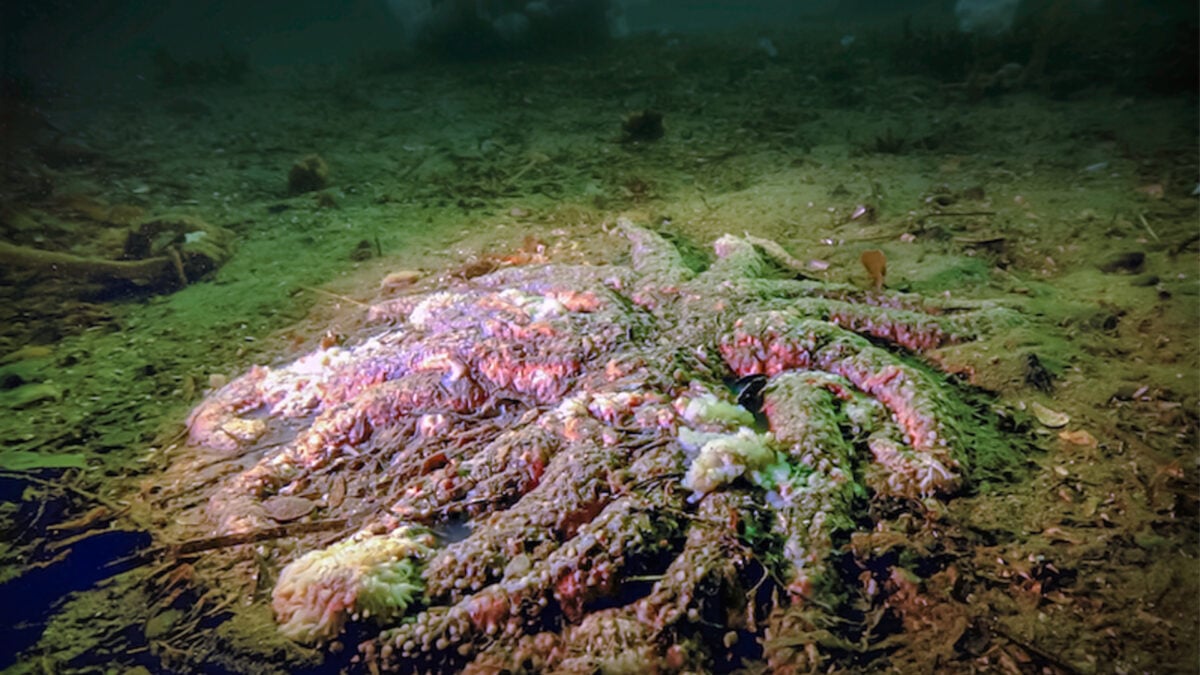
Columbo, eat your heart out: A team of scientists has just solved a massive marine murder mystery, nabbing the culprit behind the deaths of billions of sea stars over the past decade.
In a new study, researchers in the U.S. and Canada argue that the bacterial cousin of cholera is behind the epidemic. Through a series of experiments involving both wild and captive sea stars, they found evidence that Vibrio pectenicida is the likely cause of sea star wasting disease—a devastating condition that causes the invertebrates to decay and essentially “melt.”
The team’s findings appear to be well supported with evidence, Zak Swartz, a biologist specializing in sea stars at the Marine Biological Laboratory who was not involved with the study, told Gizmodo.
“This study definitely passes the sniff test for me. It seems quite convincing that V. pectenicida bacteria are at least one causative agent of SSWS,” Swartz said.
Sea stars started disappearing in 2013, when a massive outbreak of SSWD struck the North American Pacific coast. The disease swept the seas from Alaska to Mexico, decimating more than 20 different species of sea stars, which are also known as starfish. Afflicted creatures first develop visible lesions on their skin, and then their tissue starts to decay. Death by SSWD is often swift, killing the sea star within days.
There have been other mass sea star die-offs in recent decades, but the sheer scale and spread of this outbreak makes it possibly the largest marine disease epidemic ever recorded in the wild. Researchers estimate that one particular sea star species, Pycnopodia helianthoides, has lost 90% of its population to SSWD. The destruction has also dramatically changed the environments where the sea stars once thrived. In the aftermath of SSWD outbreaks, some areas have also lost kelp forests, as sea urchins—once kept in check by sea stars—decimated the underwater forests.
Marine scientists have been looking for the cause of SSWD ever since its emergence. And like any great mystery, there have been some twists. In 2014, a research team published a paper that argued a sea star-associated densovirus caused SSWD. But subsequent studies showed that this virus—or any potentially pathogenic virus for that matter—could only be found in a minority of affected species, ruling it out as the likeliest suspect.
Swartz noted that some Vibrio bacteria, however, were already known to cause disease in echinoderms—the broad group of marine invertebrates that includes sea stars. “So in a sense, it feels like the answer was hiding right under our noses. It makes total sense,” he said. Several species of Vibrio can also sicken humans, including cholera (Vibrio cholerae).
The researchers didn’t set out on this study with V. pectenicida in mind from the get-go. They exhaustively studied samples of sea stars with SSWD and healthy specimens, eventually finding that only the diseased sea stars carried high levels of the bacteria in their coelomic fluid (the invertebrate version of blood). The researchers were then able to isolate and grow new populations of the bacteria collected from the sick sea stars. And when they exposed healthy sea stars to these bacteria, the creatures rapidly developed and died from SSWD.
These experiments are the same sort used to identify and conclusively show a particular germ causes a specific disease in humans, strengthening the team’s case. Further analysis also revealed that SSWD is caused by a specific strain of the bacteria, called FHCF-3.
“Here we use controlled exposure experiments, genetic datasets, and field observations to demonstrate that the bacterium, Vibrio pectenicida strain FHCF-3, is a causative agent of SSWD,” the authors wrote in their paper, published Monday in Nature Ecology and Evolution.
Though the mystery of what causes SSWD appears solved, Swartz and the study authors note that there are still several important unanswered questions. For example, scientists aren’t sure exactly how the outbreaks start. It’s possible the bacteria could spread via sea stars’ shared food, or through physical contact with other sea stars. Low levels of the bacteria may also always be circulating in the environment, but only become a major problem under specific conditions, like at a certain temperature (Vibrio bacteria in general thrive in warmer water).
Still, given that SSWD remains a threat to sea stars, simply knowing its cause could boost sea star recovery efforts, the researchers said. It might be possible to find genetic mutations that help sea stars fend off these infections, for instance, enabling scientists to breed sea stars carrying these mutations in captivity with the aim of reintroducing them into the wild to bolster the population’s resilience.


 English
 Arabic
 French
 Spanish
 Portuguese
 Deutsch
 Turkish
 Dutch
Dutch
 Italiano
 Russian
 Romaian
 Greek
Greek