Meet Meschers, MIT's Tool for Building Paradoxical Digital Objects
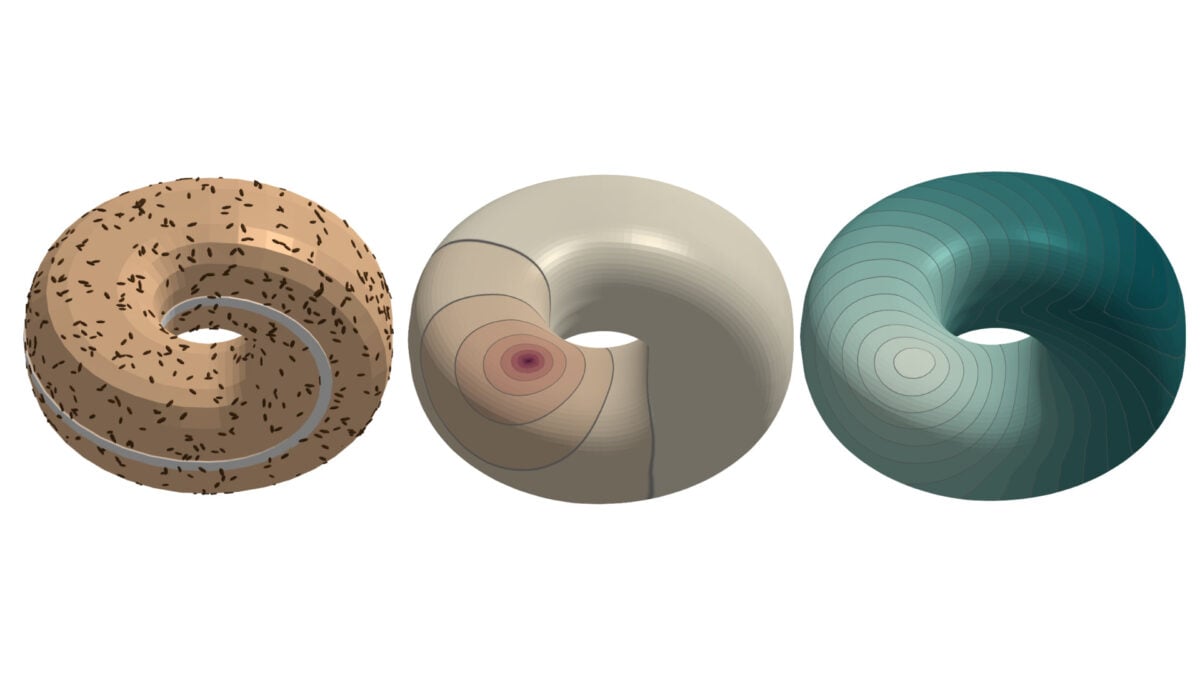
Meet “impossibagel,” a physically impossible bagel that mathematicians use to resolve intricate geometry problems. But impossibagel—and other “impossible objects” in mathematics—is notoriously difficult to replicate, and researchers haven’t been able to fully tap into their mathematical potential. That may no longer be a problem, thanks to a new tool.
On Monday, researchers at MIT’s Computer Science and Artificial Intelligence Laboratory (CSAIL) announced “Meschers,” software capable of visualizing an intricate, 2.5-dimensional representation of impossible objects. In addition to creating aesthetically quirky objects, Meschers could eventually assist in research across geometry, thermodynamics, and even art and architecture, according to the researchers. The paper, set for publication in ACM Transactions on Graphics, will be presented at the SIGGRAPH Conference next week.
“Impossible objects are constructions which cannot exist in real life and instead only exist in our perception,” Ana Dodik, study lead author and PhD student at MIT, told Gizmodo in an email. “They are interesting because our visual system can make sense of them to some extent, but they cannot exist in real life without bending or cutting them.”
Meschers (an amalgam of “meshes” and the artist M.C. Escher) offers a way to represent impossible shapes that is “consistent with our perception and that lets us do familiar ‘3D’ processing operations on them, despite them not being 3D,” she explained.

For the program, Dodik and her colleagues wove together calculus and certain aspects of the human visual system. For instance, when looking at an impossible object like the Penrose Triangle, our eyes search for something called “local consistency,” or, simply, the parts of this inconsistent shape that “make sense” to us. For the Penrose Triangle, those parts are its three L-shaped corners. Separately, these sections make sense, but when we try to connect them as a globally consistent shape, things don’t quite add up.
As such, recreating impossible objects in real life requires the object to be cut or bent, Dodik said. For computational purposes, this gave rise to issues that potentially interfered with “geometry operations, such as distance computation,” according to the researchers. Meschers addresses this complication by significantly relaxing the consistency requirement on the global scale. Instead, the program focuses on replicating the locally consistent subsections of the object.
The program also supports different lighting conditions, which can influence how well the impossible depths of these objects are represented in computational renders. The resulting shape, according to the paper, is sufficient for “a wide variety of classic geometry processing algorithms…in a way that aligns with our perceptual intuitions.”

For instance, the impossibagel would be an ideal structure for geometry researchers calculating the distance between two points on an incomprehensible surface. Alternatively, it could be used to determine how heat spreads over curved surfaces. Meschers also allows the user to inversely render an impossible object, such as deforming a torus (donut-like shape) into a Penrose Triangle, making it easier for artists or architects to play around with these unusual shapes for their own purposes.

Perhaps most importantly, it’s a way to do math that’s both fun and insightful. And it’s also great for decorating coffee mugs, as study senior author Justin Solomon shared with Gizmodo. “Our research group at MIT is the Geometric Data Processing (GDP) group, so I had this image printed on coffee mugs for all our team members,” he said. “It’s a perfect logo for our group!”
Meschers is a publicly available resource, and the code will be released shortly, the researchers say. So yes, you’ll soon be able to make an impossibagel for yourself—not to eat, but to stimulate the mathematical part of your brain!


 English
 Arabic
 Spanish
 Portuguese
 Deutsch
 Turkish
 Dutch
Dutch
 Italiano
 Russian
 Romaian
 Portuguese (Brazil)
 Greek
Greek