
Most Powerful Fast Radio Burst Ever Detected Hits Telescopes Across North America
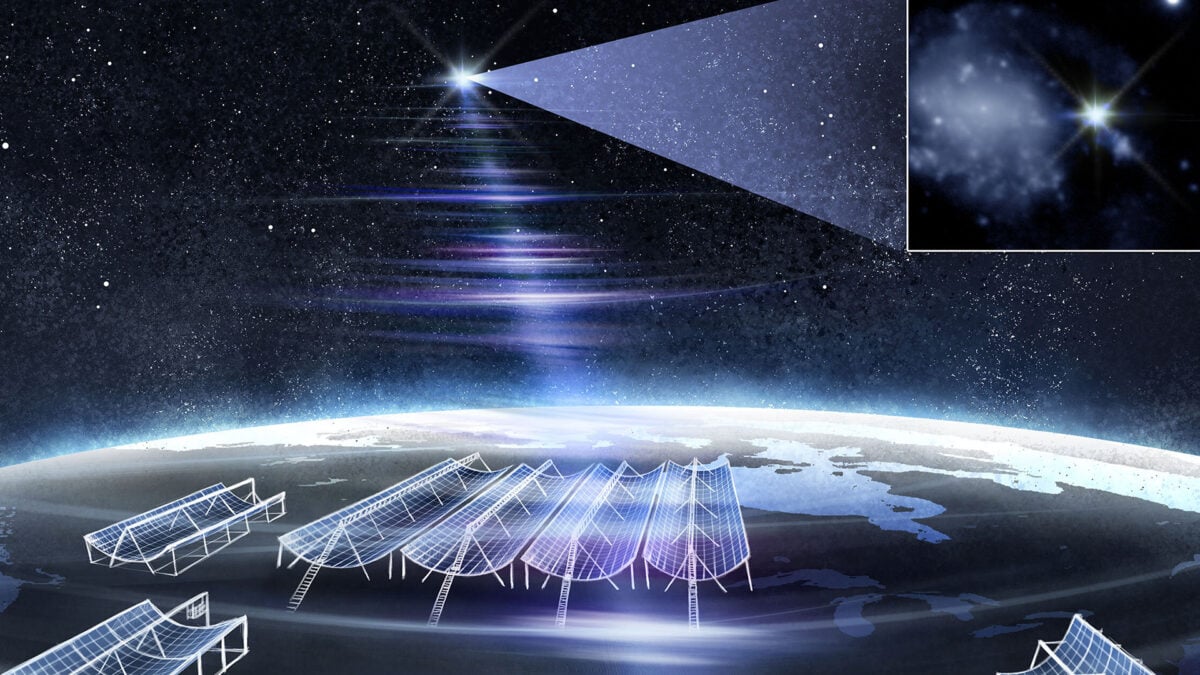
For almost two decades, astronomers have detected extremely powerful, millisecond-long flashes of radio waves known as fast radio bursts (FRBs) from beyond our galaxy—and had no clue where they came from. Now, a team of scientists has detected the brightest-ever FRB and finally pinpointed its origin to a nearby galaxy.
Researchers have long suspected that FRBs are the result of highly energetic and violent events, like clashes between neutron stars. But even though they can generate more energy in a burst than our Sun emits in a year, they’re gone in less time than it takes to blink. Due to their transient nature, astronomers have been unable to locate exactly where they originated until now.
“We were detecting lots of FRBs, but only had crude information on where they were occurring in the sky,” Bryan Gaensler, a co-author of the study and dean of the UC Santa Cruz Science Division, said in a statement. “It was like talking to someone on the phone and not knowing what city or state they were calling from.”
To which he added: “Now we know not only their exact address, but which room of their house they’re standing in while they’re on the call.”
The burst’s brightness and its proximity are giving researchers new clues as to not just where the flash originated but also what caused it. The findings were published in The Astrophysical Journal Letters.
The GOAT of fast radio bursts
Astronomers detected this exceptionally bright FRB, formally referred to as FRB 20250316A, in March from the direction of the Big Dipper using the CHIME radio telescope in British Columbia. They’re referring to the flash as “RBFLOAT” for “Radio Brightest Flash Of All Time.” The flash produced more energy in a few milliseconds than our Sun produces in four days.
The astronomers pinpointed the flash thanks to the Canadian Hydrogen Intensity Mapping Experiment (CHIME), a large radio telescope in B.C., and its newly completed “outrigger” telescope array, which spans across North America from B.C. to West Virginia. This vast network, which went live a few months ago, is sensitive enough to detect ultrafast, bright radio flashes.
While many FRBs repeat, pulsing multiple times across several months, RBFLOAT emitted all its energy in just one burst. In hundreds of hours after it was first observed, astronomers did not detect another burst from the source.
Astronomers traced the burst to a region just 45 light-years across—smaller than the average star cluster—in the outskirts of a galaxy about 130 million light-years away. RBFLOAT occurred along a spiral arm of that galaxy, which is dotted with many star-forming regions. The burst originated near, but not inside, one of these regions, according to the study.
“It is remarkable that only a couple of months after the full Outrigger array went online, we discovered an extremely bright FRB in a galaxy in our own cosmic neighborhood,” Wen-fai Fong, a senior author on the study and professor of physics and astronomy at Northwestern University, said in a statement.
Solving the cosmic mystery
Then, using data from the Keck Cosmic Web Imager, a spectrographic instrument on the 10-meter Keck II Telescope in Hawai’i, the researchers were able to study RBFLOAT’s surroundings. This included the physical properties of the gaseous environment the FRB originated from, including the rate of star production in the galaxy, the total amount of gas present at any location in the galaxy, and its density.
But it’s still a mystery what exactly caused the flash. The team suspects that it was produced by a magnetar—a highly magnetized neutron star left behind after a supernova.
“Spiral arms are typically sites of ongoing star formation, which supports the idea that it came from a magnetar. Using our extremely sensitive MMT image, we were able to zoom in further and found that the FRB is actually outside the nearest star-forming clump. This location is intriguing because we would expect it to be located within the clump, where star formation is happening,” Northwestern graduate student Yuxin “Vic” Dong and study coauthor said in a statement.
“This could suggest that the progenitor magnetar was kicked from its birth site or that it was born right at the FRB site and away from the clump’s center,” Dong added.
With the CHIME Outriggers now fully running, astronomers expect to pinpoint more FRBs each year, perhaps bringing us closer to understanding their origins.
“This result marks a turning point,” study author Amanda Cook, a postdoctoral researcher at McGill University, said in a statement. “Instead of just detecting these mysterious flashes, we can now see exactly where they are coming from. It opens the door for discovering whether they are caused by dying stars, exotic magnetic objects or something we haven’t even thought of yet.”


 English
 Arabic
 French
 Spanish
 Portuguese
 Turkish
 Dutch
Dutch
 Italiano
 Russian
 Romaian
 Portuguese (Brazil)
 Greek
Greek