
CERN Researchers Uncover Crucial Element in the Matter-Antimatter Enigma
All matter in our universe has an evil twin: antimatter. Cosmological models suggest that the Big Bang should have created equal amounts of matter and antimatter that cancel each other out. But for reasons physicists still aren’t completely sure about, that didn’t happen. As a result, our universe today hosts slightly more matter than antimatter—our very existence being clear, physical proof.
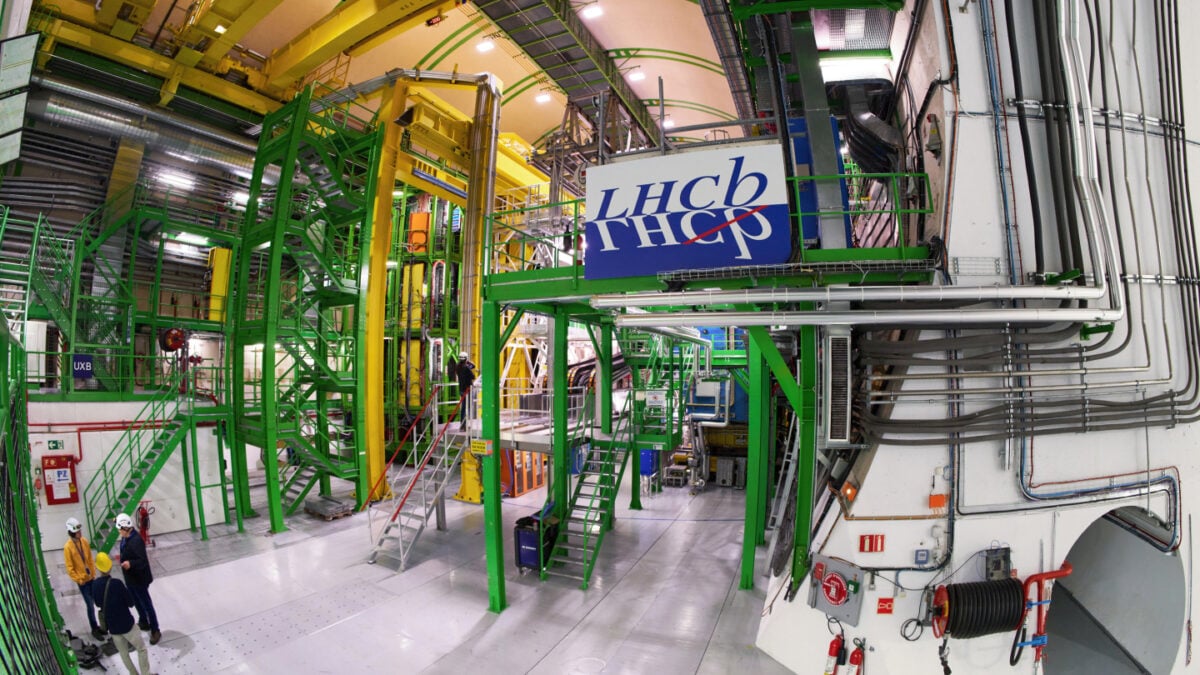
Now, we might be one step closer to explaining why there’s an imbalance between matter and antimatter, an unsolved mystery in physics formally known as the charge-parity (CP) violation, or CP asymmetry. In a paper published today in Nature, researchers at the Large Hadron Collider beauty (LHCb) Collaboration at CERN, Switzerland, report the first experimental verification of the CP violation in the decay of baryons—fundamental particles that make up most matter in the observable universe. The results were announced earlier this year at the Rencontres de Moriond conference.
“Until recently, CP violation had only been clearly observed in mesons [or] particles made of a quark and an antiquark,” explained Xueting Yang, LHC physicist and study lead author, in an email to Gizmodo. “This result shows that baryons—which are made of three quarks like protons and neutrons—can also violate CP symmetry.”
[embed]https://www.youtube.com/watch?v=negiPvWHaMc[/embed]
While a significant first step, the new finding still falls short of observing baryon asymmetry, which refers to that paradox of there being more matter than antimatter in the universe today. What Yang’s team observed specifically was an instance of CP violation in baryon decay, or the slight difference in behavior between a baryon and its antimatter counterpart as the particle breaks down into smaller particles.
“Well, it’s a small part of a much bigger puzzle—but you know, every part matters,” Sean Carroll, a theoretical physicist at Johns Hopkins University who wasn’t involved in the new work, told Gizmodo in a video call. “It’s intrinsically interesting when you find a phenomenon that has never been observed before, but…maybe it will teach us something about why there are more baryons than anti-baryons in the universe.”
For the study, Yang’s team took around nine years of data from observing the decay of almost one trillion beauty-lambda (Λb) baryons, the heavyweight cousin-particle of protons and neutrons. In about a mere trillionth of a second, beauty-lambda baryons and their antimatter counterparts break down into smaller parts, requiring the technical prowess of something as big as the LHC to capture.
From the data, the researchers sifted through the different interactions to pick out the ones of interest to them, namely the decay behavior of beauty-lambda baryons and their antimatter counterparts. “If CP symmetry were true, you’d have exactly the same rate for these interactions,” Carroll explained. “But it is violated, so you get slightly different rates.”
That rate was about 2.5%, a small but statistically significant difference—at least, enough for the team to start brainstorming ideas for how they’d like to build on this result.
“Studying how baryons are formed, how they interact, and how they decay is essential to understanding the fundamental forces of nature,” Yang said. “This observation marks just the beginning. To answer why [the universe contains] more matter than antimatter, we need more sources of CP violation than the current [Standard Model of particle physics].”
The Standard Model—the theory that describes particle behavior with chilling accuracy—is both the magnum opus and the punching bag of particle physics. It explains everything so ludicrously well, while missing some huge chunks of known physical phenomena, such as gravity or dark matter, to name a few. And so, when the LHC came along, physicists expected it to achieve great things—which it did, and continues to do. But as with all great physics discoveries, it’s a holy grail that’ll take some more time to realize.
“We were, to be honest, a little bit disappointed that the Large Hadron Collider hasn’t found any physics beyond the Standard Model,” Carroll said. “But I think it’s super important to keep looking. The LHC is a beautiful machine that has done amazing work—and yet, it hasn’t quite taken us to the promised land. So it’s another reminder that there are really big questions out there, and one way or the other we, as the human race, should be doing our best to answer them.”


 English
 French
 Spanish
 Portuguese
 Deutsch
 Turkish
 Dutch
Dutch
 Italiano
 Russian
 Romaian
 Portuguese (Brazil)
 Greek
Greek