
Our Best View Yet of Interstellar Comet 3I/ATLAS
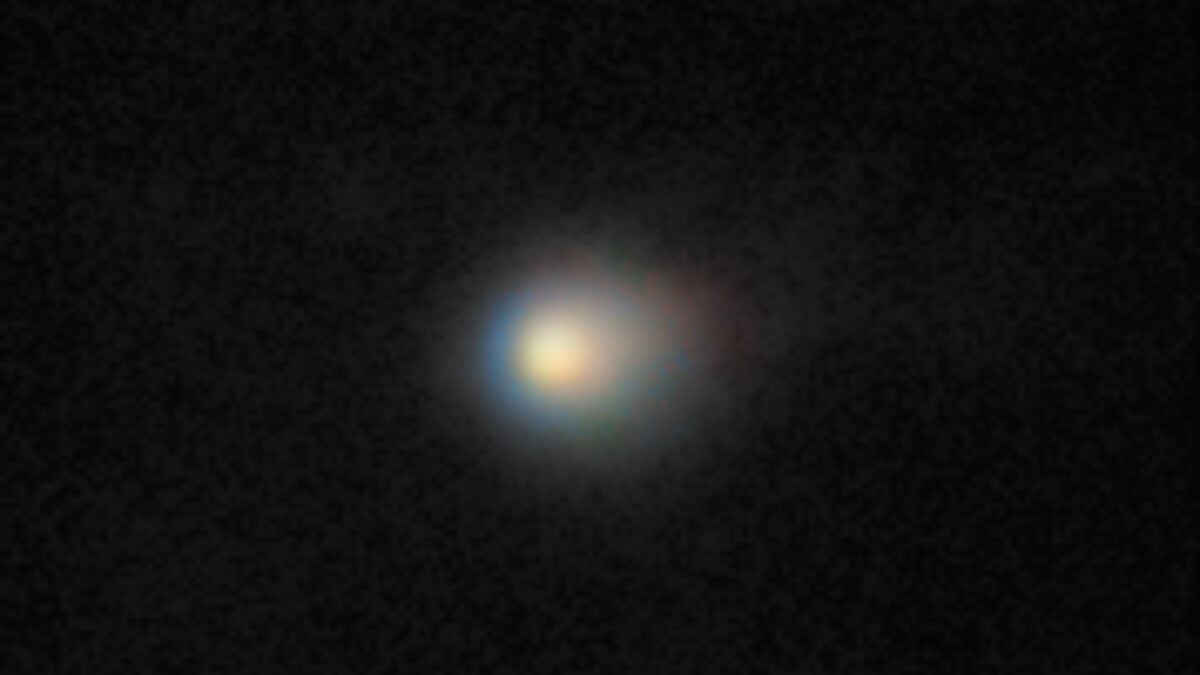
A comet unlike any seen before has fixated astronomers around the world. An observatory in Hawaii has unveiled the most stunning image of this ancient interstellar visitor yet.
The Gemini North telescope on Maunakea, Hawaii, recently snapped a close-up of 3I/ATLAS, the third interstellar object ever discovered. The telescope’s highly sensitive Multi-Object Spectrograph captured the comet’s compact coma—a cloud of gas and dust surrounding its icy nucleus—in striking detail. 3I/ATLAS is inbound to the inner solar system, and as it approaches the Sun and heats up, its coma will expand and make the comet appear brighter. Observing this uptick in activity, known as cometary outgassing, will allow astronomers to gain more insight into the composition of 3I/ATLAS. Understanding what this interstellar comet is made of will offer a glimpse of the conditions and processes that shaped the distant star system from which it came.
“The sensitivity and scheduling agility of the International Gemini Observatory has provided critical early characterization of this interstellar wanderer,” Martin Still, NSF program director for the International Gemini Observatory, said in a statement. “We look forward to a bounty of new data and insights as this object warms itself on sunlight before continuing its cold, dark journey between the stars.”

The International Astronomical Union’s Minor Planet Center confirmed that this comet came from outside our solar system on July 2. Since then, astronomers have been racing to gather as much data on it as possible. Preliminary findings suggest 3I/ATLAS is the oldest comet ever found, roughly 2 billion years older than our solar system. What’s more, it appears to have come from an underexplored region of the Milky Way’s galactic disk. This is the disk-like component of our galaxy containing stars, gas, and dust that rotates in a circular coplanar motion around the center of the galaxy. Based on its trajectory, 3I/ATLAS likely came from the thick part of the disk, which contains roughly 10% of the stellar mass of the Milky Way. Stars located in the thick disk are generally much older than those located in the galaxy’s thin disk.
This comet is older, larger, and faster than the two interstellar objects that came before it: ‘Oumuamua and Comet 2I/Borisov. One recent study, which has yet to undergo peer review, found that 3I/ATLAS has a hyperbolic velocity of about 37 miles per second (60 kilometers per second). That’s roughly twice the speed of both ‘Oumuamua and Borisov. The researchers also estimated the newly discovered comet to be up to 6 miles (10 kilometers) wide, which would make it 100 times wider than ‘Oumuamua and 10 times wider than Borisov. If 3I/ATLAS truly is that big, this would imply that galaxies are far more efficient at making these kinds of objects than scientists thought. The study authors note, however, that estimations of this comet’s size will likely shrink as astronomers gather more observations.
The Gemini Observatory and many others across the globe will continue using a wide variety of telescopes to observe 3I/ATLAS as it rockets toward the Sun. The comet should make its closest approach to our home star on October 29 and its closest approach to Earth on October 30. It will keep a safe distance from our planet, but the flyby will still allow astronomers to gather more detailed observations of this comet before it leaves our solar system for good.
Such studies could begin to unravel the many mysteries of 3I/ATLAS, as its characteristics remain largely unknown. Still, it’s already becoming clear that this interstellar comet is totally different from any we’ve seen before, offering brand new insights into galactic processes beyond our solar system.


 English
 Arabic
 Spanish
 Portuguese
 Deutsch
 Turkish
 Dutch
Dutch
 Italiano
 Russian
 Romaian
 Portuguese (Brazil)
 Greek
Greek