
Playful Airline Safety Videos Could Be Making Passengers Less Safe
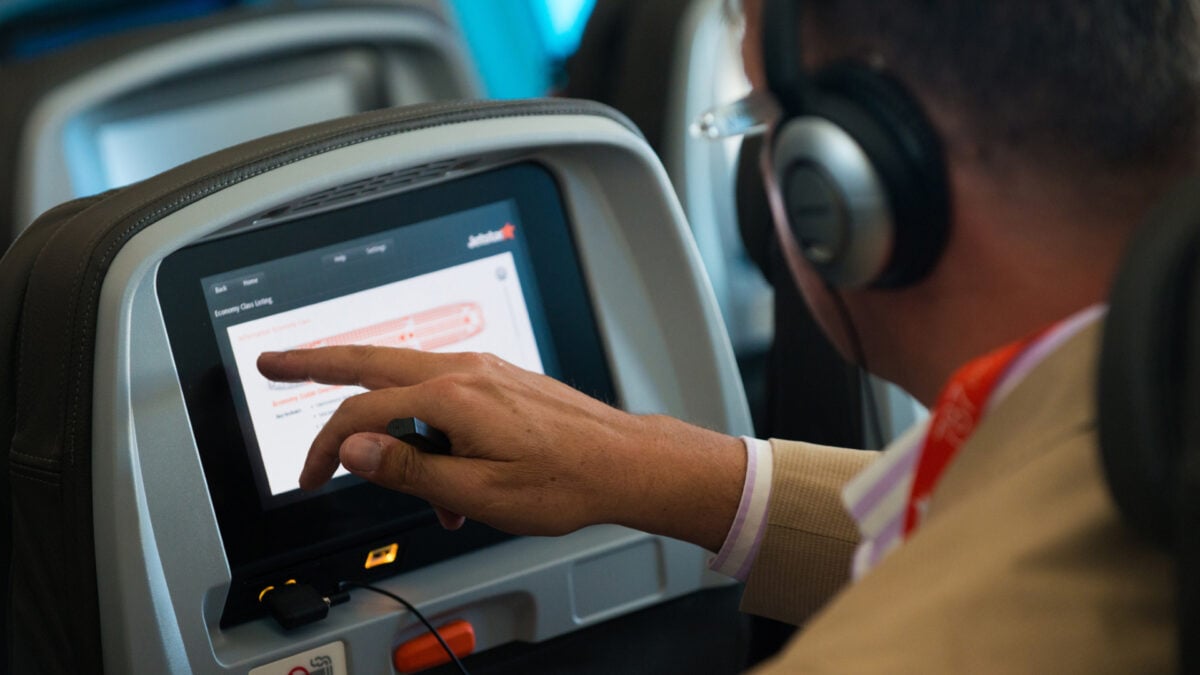
When you board a plane, chances are you want to stick your noise-canceling earphones in as soon as possible and pass out before the toddler in the row behind you starts screaming. Plus, if you’re a frequent traveler, you probably know the in-flight safety video by heart. Or do you?
A survey published last month in the Journal of Travel Research reveals that not only did most participants fail an airline safety quiz immediately after watching the in-flight safety video, but that viewers of videos enriched with tourism marketing were even more likely to forget the guidelines. Given that, according to the United States National Transportation Safety Board, attentiveness to safety demonstrations can significantly affect a passenger’s chances of surviving a plane crash, the study carries implications for how these safety measures should be delivered.
And then there’s the realization that many airlines’ safety videos now incorporate tourism marketing, such as Air New Zealand’s Lord of the Rings-themed safety video, which has more than 25 million views on YouTube.
[embed]https://www.youtube.com/watch?v=qOw44VFNk8Y[/embed]
“This research was motivated, in part, by the popularity of these newer safety videos,” Yaqi Gong, doctoral candidate in recreation, park, and tourism management at Pennsylvania State University (Penn State) and first author of the new study, said in a university statement. “It was clear that these videos were grabbing people’s attention, so we wanted to determine if they affected people’s travel plans and ability to recall safety information.”
As such, Gong and colleagues investigated the effectiveness of safety-demonstration videos with tourism content from four national flagship airlines—Nepal Airlines, Air Mauritius, Sri Lankan Airlines, and Singapore Airlines—versus other videos without it. In their study, 214 participants in the U.S. watched one of the airline safety videos and then answered questions related to the video’s content, such as “True-or-false: If you have a child, put on the oxygen mask for your child first” and “True-or-false: Baggage should be left on the flight when there is an emergency evacuation.”
The study revealed that “while it does not influence perceived safety or compliance intentions, the inclusion of destination content, particularly when presented through live-shot imagery, positively impacts destination image and increases visit intentions. However, this comes at the cost of reduced memory recall among viewers,” the researchers wrote in the study.
In other words, safety videos with live-action, local images led viewers to express an improved view of the country while influencing their travel intentions.
“By creating a positive image and association in the mind of a traveler, these videos can change the impression people have of a place, which can encourage and enhance tourist activity,” said Bing Pan, Penn State professor of recreation, park, and tourism management and another co-author of the study. “Additionally, these images can influence what visitors want to see in the nation.”
The problem, however, is that viewers of safety videos with promotional content also remembered fewer safety protocols. Specifically, they were 11% less likely to correctly answer the safety questions. “It seems that there is a tradeoff between engaging content and remembering safety instructions,” Pan explained. “It is possible that exciting local images distract people from the safety messaging. This may be why they remembered less of the important information.”
However, the researchers emphasize that the study was not conducted in a real-world environment. The participants did not watch the videos while on an actual plane, where the environment could lead to different results. For example, people on planes might be more inclined to engage with an entertaining video with marketing elements but completely ignore a traditional safety video.
Overall, however, the viewers didn’t retain much information from either video. On average, they responded correctly to only about two of five true-or-false questions.
“Most people retained less than half of the critical information from the safety-demonstration videos, so everyone really needs to pay attention to safety demonstrations—whether or not those videos are engaging,” Gong concluded. “You may think you know the safety information, but our data shows there is a good chance you do not. So, please watch the safety demonstration. It could save your life.”


 English
 Arabic
 French
 Spanish
 Portuguese
 Deutsch
 Turkish
 Dutch
Dutch
 Italiano
 Russian
 Romaian
 Greek
Greek