
Twist on Famous Double-Slit Experiment Deals a Blow to Einstein's Quantum Doubts
Albert Einstein famously disliked quantum theory’s understanding that physical objects, including light, exist as both a particle and a wave, and that this duality could not be simultaneously observed. But a new, simple iteration of a foundational quantum experiment offers the most conclusive, direct evidence yet that Einstein may have been wrong.
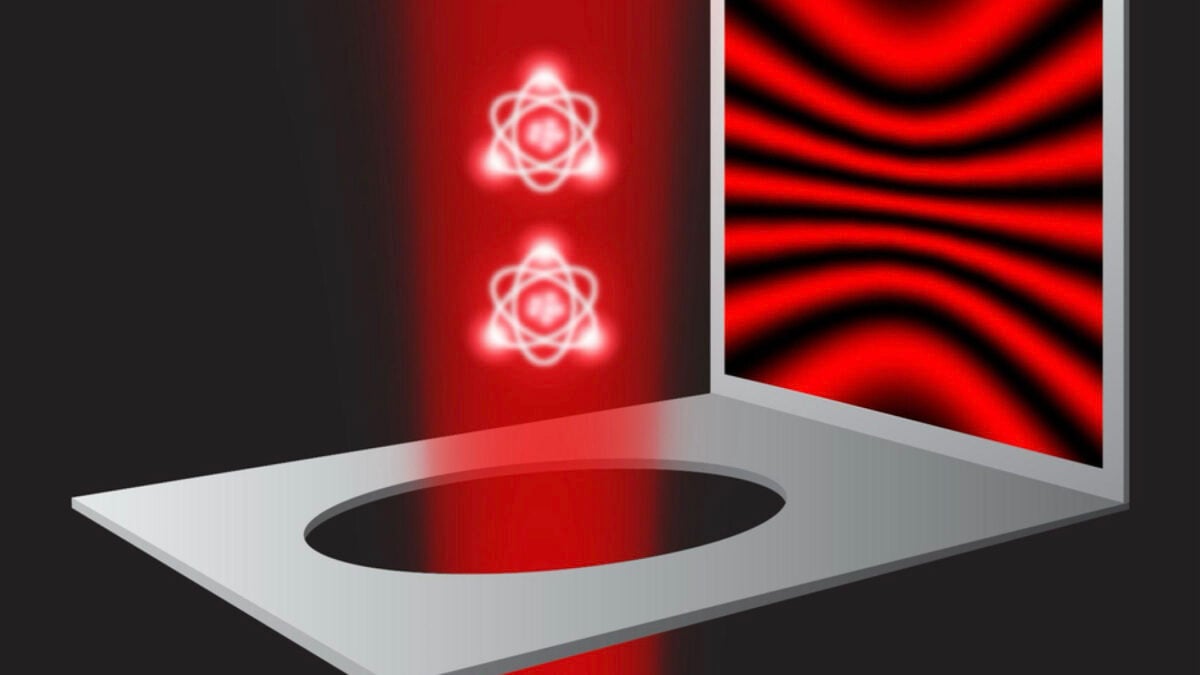
In a recent paper for Physical Review Letters, MIT scientists successfully replicated the double-slit experiment on the atomic scale, allowing for an unprecedented level of empirical precision. By using supercold atoms as “slits” for light to pass through, the team confirmed that the wave-particle duality of light—with all its paradoxical properties—holds up even on the most fundamental quantum scales.
The double-slit experiment, first performed in 1801 by British physicist Thomas Young, illustrates the dual nature of light in the quantum world. When you shine a beam of light—photon “particles” following a direct path—through two parallel slits on a screen, what appears on the other side is an interference pattern resembling the union of two ripples in a pond, like a “wave.” But if you try to catch this mysterious transition in action by peering into the slit, you lose the interference pattern.
Niels Bohr, Einstein’s main opponent in this debate, referred to this result as complementarity, the idea that it’s impossible to simultaneously measure complementary properties of a quantum system. But Einstein surmised that, if a paper-thin slit held in place by a spring was struck with light, the individual photons would shake the spring in a particle-like manner. That way, we could catch the duality of light in action.

To test this hypothesis, the MIT team stripped down their experimental setup to the scale of single atoms, which they cooled down to microkelvin temperatures (for context, one kelvin is equivalent to -460 degrees Fahrenheit or -272 degrees Celsius). They used lasers to arrange more than 10,000 atoms into a neat, crystal-like configuration. This highly controlled environment allowed the researchers to adjust each atom’s “fuzziness,” or the certainty of its location. Simply, a fuzzier atom increases the probability that a photon passing through will exhibit particle-like behavior.
“These single atoms are like the smallest slits you could possibly build,” explained Wolfgang Ketterle, the study’s senior author, to MIT News. By repeatedly bombarding the atomic “slits” with photons, Ketterle, a 2001 Nobel laureate, and his team were able to record the diffraction pattern from the photons scattering off the atomic slits.
What they found, unsurprisingly, was that Bohr was correct. The more they zoomed in on the path of an individual photon, the weaker the diffraction pattern became, confirming we can’t observe light as both a wave and a particle simultaneously. They also tried shutting off the lasers holding the atoms in place—the “spring” for their setup. Even then, it was impossible to track a photon’s path without disrupting the wave-like interference pattern.
“In many descriptions, the springs play a major role. But we show, no, the springs do not matter here; what matters is only the fuzziness of the atoms,” explained Vitaly Fedoseev, study lead author, also to MIT News. “Therefore, one has to use a more profound description [like Bohr’s complementarity], which uses quantum correlations between photons and atoms.”
Einstein is sometimes accused of hating quantum physics. This isn’t necessarily true. Einstein believed quantum theory needed more work, especially regarding its overreliance on randomness—but he never completely rejected its validity. As he wrote in a famous letter to physicist Max Born, quantum mechanics is “certainly imposing,” but his instinct is that it’s “not yet the real thing…[God] is not playing dice.”
Einstein had a lot of questions about quantum mechanics, many of which remain unanswered. And as the Einstein-Bohr debate—and the new MIT finding—illustrates, his rigorous, provocative challenges to what physicists take for granted continue to advance our understanding of the weird, paradoxical world of quantum mechanics.


 English
 Arabic
 French
 Portuguese
 Deutsch
 Turkish
 Dutch
Dutch
 Italiano
 Russian
 Romaian
 Portuguese (Brazil)
 Greek
Greek